Communication Design and Strategy
Type: Client Project (Saytrees)
Communication design | Information design | Social design | Reasearch and Strategy | Service design | Print Design
Designing strategy and contextual tools, to support agroforestry adoption among farmers
SayTrees is an environmental NGO helping farmers in drought-prone regions shift from monocropping to sustainable agriculture. Our project focused on studying their existing approach and creating contextual tools and strategies to strengthen farmer understanding and adoption.
Role: Supporting Research (field studies, farmer insights, analysis and strategy), Content design(extracting, streamlining, structuring), Design (visual collaterals, layouts, illustrations) and Collaboration (in research & strategy)
Tools used : InDesign · Photoshop · Illustrator · Procreate
Duration: 7 months · 2024
Communication Design and Strategy
Type: Client Project (Saytrees)
Communication design | Information design | Social design | Reasearch and Strategy | Service design | Print Design
Designing strategy and contextual tools, to support agroforestry adoption among farmers
SayTrees is an environmental NGO helping farmers in drought-prone regions shift from monocropping to sustainable agriculture. Our project focused on studying their existing approach and creating contextual tools and strategies to strengthen farmer understanding and adoption.
Role: Supporting Research (field studies, farmer insights, analysis and strategy), Content design(extracting, streamlining, structuring), Design (visual collaterals, layouts, illustrations) and Collaboration (in research & strategy)
Tools used : InDesign · Photoshop · Illustrator · Procreate
Duration: 7 months · 2024
Communication Design and Strategy
Type: Client Project (Saytrees)
Communication design | Information design | Social design | Reasearch and Strategy | Service design | Print Design
Designing strategy and contextual tools, to support agroforestry adoption among farmers
SayTrees is an environmental NGO helping farmers in drought-prone regions shift from monocropping to sustainable agriculture. Our project focused on studying their existing approach and creating contextual tools and strategies to strengthen farmer understanding and adoption.
Role: Supporting Research (field studies, farmer insights, analysis and strategy), Content design(extracting, streamlining, structuring), Design (visual collaterals, layouts, illustrations) and Collaboration (in research & strategy)
Tools used : InDesign · Photoshop · Illustrator · Procreate
Duration: 7 months · 2024

Challenge
Despite receiving saplings, training, and on-ground guidance, many farmers remained hesitant to shift from monocropping to multicropping practices. A variety of factors contributed to this reluctance — difficulty in visualizing long-term benefits, lack of family support, communication gaps, and the overall complexity of the concept itself.
The core challenge lay in helping farmers grasp and relate to the ideas of multicropping and agroforestry in a way that was simplified, contextual, and motivating. At the same time, from an organizational perspective, it was essential to relook at SayTrees’ existing implementation journey — the touchpoints and interactions, and identify where interventions could amplify adoption, strengthen impact, and improve conversion rates.
Challenge
Despite receiving saplings, training, and on-ground guidance, many farmers remained hesitant to shift from monocropping to multicropping practices. A variety of factors contributed to this reluctance — difficulty in visualizing long-term benefits, lack of family support, communication gaps, and the overall complexity of the concept itself.
The core challenge lay in helping farmers grasp and relate to the ideas of multicropping and agroforestry in a way that was simplified, contextual, and motivating. At the same time, from an organizational perspective, it was essential to relook at SayTrees’ existing implementation journey — the touchpoints and interactions, and identify where interventions could amplify adoption, strengthen impact, and improve conversion rates.
Challenge
Despite receiving saplings, training, and on-ground guidance, many farmers remained hesitant to shift from monocropping to multicropping practices. A variety of factors contributed to this reluctance — difficulty in visualizing long-term benefits, lack of family support, communication gaps, and the overall complexity of the concept itself.
The core challenge lay in helping farmers grasp and relate to the ideas of multicropping and agroforestry in a way that was simplified, contextual, and motivating. At the same time, from an organizational perspective, it was essential to relook at SayTrees’ existing implementation journey — the touchpoints and interactions, and identify where interventions could amplify adoption, strengthen impact, and improve conversion rates.

Key considerations
Gauging the Farmer Mindsets – What they already know and how they grasp agroforestry and new multi-cropping concepts, as well as their mindsets toward them.
Seeing the Bigger Picture – Mapping the ecosystem from farmers, field team, and organization perspectives to identify enablers as well as gaps.
Designing for Context – Keeping visuals and content to be developed grounded in local realities and demographics.
Including Stakeholders – Bringing their voices and perspectives into every step of the project.
Simplifying Technical Concepts – Making complex information easy to understand and use for farmers.
Key considerations
Gauging the Farmer Mindsets – What they already know and how they grasp agroforestry and new multi-cropping concepts, as well as their mindsets toward them.
Seeing the Bigger Picture – Mapping the ecosystem from farmers, field team, and organization perspectives to identify enablers as well as gaps.
Designing for Context – Keeping visuals and content to be developed grounded in local realities and demographics.
Including Stakeholders – Bringing their voices and perspectives into every step of the project.
Simplifying Technical Concepts – Making complex information easy to understand and use for farmers.
Key considerations
Gauging the Farmer Mindsets – What they already know and how they grasp agroforestry and new multi-cropping concepts, as well as their mindsets toward them.
Seeing the Bigger Picture – Mapping the ecosystem from farmers, field team, and organization perspectives to identify enablers as well as gaps.
Designing for Context – Keeping visuals and content to be developed grounded in local realities and demographics.
Including Stakeholders – Bringing their voices and perspectives into every step of the project.
Simplifying Technical Concepts – Making complex information easy to understand and use for farmers.
Field Immersion and Research
The team began with field immersion to understand agroforestry and multi-cropping in practice:
Observing live models and mapping farmer mindsets and awareness
Understanding the implementation system, logistics, enablers, and barriers
Capturing insights from both farmer and organizational perspectives, before and after program adoption
Next, the team mapped scenarios to identify best- and worst-case farmer situations based on:
Water, land, and soil quality
Digital access and market dependency
Family, community, and organizational support
Socioeconomic conditions and farm management (pest control, labor, crop choice)
During this stage, the team also considered field team challenges, including gaps in reaching and convincing farmers to adopt new practices.
Field Immersion and Research
The team began with field immersion to understand agroforestry and multi-cropping in practice:
Observing live models and mapping farmer mindsets and awareness
Understanding the implementation system, logistics, enablers, and barriers
Capturing insights from both farmer and organizational perspectives, before and after program adoption
Next, the team mapped scenarios to identify best- and worst-case farmer situations based on:
Water, land, and soil quality
Digital access and market dependency
Family, community, and organizational support
Socioeconomic conditions and farm management (pest control, labor, crop choice)
During this stage, the team also considered field team challenges, including gaps in reaching and convincing farmers to adopt new practices.
Field Immersion and Research
The team began with field immersion to understand agroforestry and multi-cropping in practice:
Observing live models and mapping farmer mindsets and awareness
Understanding the implementation system, logistics, enablers, and barriers
Capturing insights from both farmer and organizational perspectives, before and after program adoption
Next, the team mapped scenarios to identify best- and worst-case farmer situations based on:
Water, land, and soil quality
Digital access and market dependency
Family, community, and organizational support
Socioeconomic conditions and farm management (pest control, labor, crop choice)
During this stage, the team also considered field team challenges, including gaps in reaching and convincing farmers to adopt new practices.
Field Immersion Insights: Snapshots from the first field visit, with parameters mapped from best- to worst-case scenarios.
Field Immersion Insights: Snapshots from the first field visit, with parameters mapped from best- to worst-case scenarios.
Field Immersion Insights: Snapshots from the first field visit, with parameters mapped from best- to worst-case scenarios.

Mapping and analysis
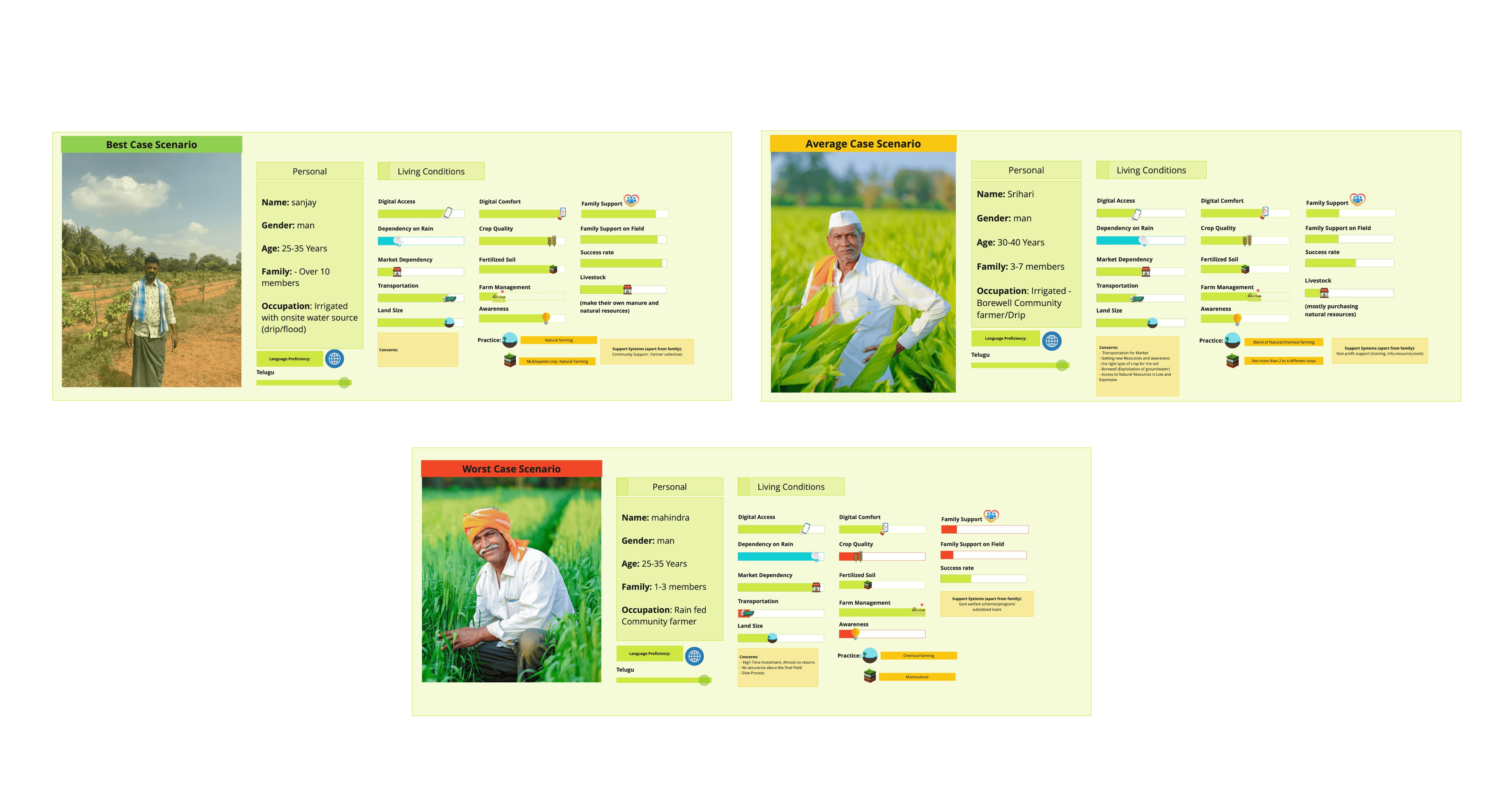
After gaining a foundational understanding of farmer mindsets and field team perspectives, the team began by mapping personas based on various scenarios mapped:
Scenario Mapping
We mapped three scenarios: best-case, average-case, and worst-case. This helped us understand the parameters affecting farmer success, including water, land and soil quality, family support, market access, community support, and farm management practices.Stakeholder Mapping
We also mapped all stakeholders, considering dimensions such as authority, dependence, influence, support, and trust. This clarified the role of each stakeholder in ensuring successful program implementation.
Mapping and analysis
After gaining a foundational understanding of farmer mindsets and field team perspectives, the team began by mapping personas based on various scenarios mapped:
Scenario Mapping
We mapped three scenarios: best-case, average-case, and worst-case. This helped us understand the parameters affecting farmer success, including water, land and soil quality, family support, market access, community support, and farm management practices.Stakeholder Mapping
We also mapped all stakeholders, considering dimensions such as authority, dependence, influence, support, and trust. This clarified the role of each stakeholder in ensuring successful program implementation.
Mapping and analysis
After gaining a foundational understanding of farmer mindsets and field team perspectives, the team began by mapping personas based on various scenarios mapped:
Scenario Mapping
We mapped three scenarios: best-case, average-case, and worst-case. This helped us understand the parameters affecting farmer success, including water, land and soil quality, family support, market access, community support, and farm management practices.Stakeholder Mapping
We also mapped all stakeholders, considering dimensions such as authority, dependence, influence, support, and trust. This clarified the role of each stakeholder in ensuring successful program implementation.
Scenario-Based Persona & Stakeholder Mapping Farmer personas (best, average, worst case scenario) and stakeholder roles with authority, influence, and trust.
Scenario-Based Persona & Stakeholder Mapping Farmer personas (best, average, worst case scenario) and stakeholder roles with authority, influence, and trust.
Scenario-Based Persona & Stakeholder Mapping Farmer personas (best, average, worst case scenario) and stakeholder roles with authority, influence, and trust.

Farmer Journey Mapping
Mapped the entire farmer journey, from initial awareness and interest to post-plantation and sales, based on field observations. At each stage, enablers and barriers affecting awareness, adoption, management, and post-management outcomes were identified.Field Team Insights
Spoke with prominent field teams from both the Maharashtra and South India cohorts to validate understanding and add depth to the journey mapping. The teams explained their approach to the pre-enrollment stage, including:Challenges faced by both field teams and farmers
Topics discussed with farmers
Tools or aids currently used in their process
These insights were mapped separately for the Maharashtra and South India cohorts to capture regional differences.
Farmer Journey Mapping
Mapped the entire farmer journey, from initial awareness and interest to post-plantation and sales, based on field observations. At each stage, enablers and barriers affecting awareness, adoption, management, and post-management outcomes were identified.Field Team Insights
Spoke with prominent field teams from both the Maharashtra and South India cohorts to validate understanding and add depth to the journey mapping. The teams explained their approach to the pre-enrollment stage, including:Challenges faced by both field teams and farmers
Topics discussed with farmers
Tools or aids currently used in their process
These insights were mapped separately for the Maharashtra and South India cohorts to capture regional differences.
Farmer Journey Mapping
Mapped the entire farmer journey, from initial awareness and interest to post-plantation and sales, based on field observations. At each stage, enablers and barriers affecting awareness, adoption, management, and post-management outcomes were identified.Field Team Insights
Spoke with prominent field teams from both the Maharashtra and South India cohorts to validate understanding and add depth to the journey mapping. The teams explained their approach to the pre-enrollment stage, including:Challenges faced by both field teams and farmers
Topics discussed with farmers
Tools or aids currently used in their process
These insights were mapped separately for the Maharashtra and South India cohorts to capture regional differences.
Figure 1 - Complete farmer journey from awareness to post-management. Figure 2 - Maharashtra journey pre-enrollment process, challenges, and tools. Figure 3 - South India team journey pre-enrollment process, challenges, and tools.
Figure 1 - Complete farmer journey from awareness to post-management. Figure 2 - Maharashtra journey pre-enrollment process, challenges, and tools. Figure 3 - South India team journey pre-enrollment process, challenges, and tools.


Insights
This mapping provided a holistic understanding of:
All parameters that impact farmer success
All stakeholders involved in implementation
Challenges, touchpoints, and current tools
It also established a strong foundation for identifying effective interventions
Other key insights included:
Farmer success depends on water, soil, land, support systems, and farm management
Awareness gaps exist – Farmers need simple, actionable guidance tailored to their understanding
Stakeholder roles matter – Local authorities, organizations, and communities strongly influence adoption and success
Touchpoints revealed barriers – Awareness, enrollment, management, and post-management stages each need targeted support
Solutions had to reflect local realities, culture, and demographics to be effective
Insights
This mapping provided a holistic understanding of:
All parameters that impact farmer success
All stakeholders involved in implementation
Challenges, touchpoints, and current tools
It also established a strong foundation for identifying effective interventions
Other key insights included:
Farmer success depends on water, soil, land, support systems, and farm management
Awareness gaps exist – Farmers need simple, actionable guidance tailored to their understanding
Stakeholder roles matter – Local authorities, organizations, and communities strongly influence adoption and success
Touchpoints revealed barriers – Awareness, enrollment, management, and post-management stages each need targeted support
Solutions had to reflect local realities, culture, and demographics to be effective
Insights
This mapping provided a holistic understanding of:
All parameters that impact farmer success
All stakeholders involved in implementation
Challenges, touchpoints, and current tools
It also established a strong foundation for identifying effective interventions
Other key insights included:
Farmer success depends on water, soil, land, support systems, and farm management
Awareness gaps exist – Farmers need simple, actionable guidance tailored to their understanding
Stakeholder roles matter – Local authorities, organizations, and communities strongly influence adoption and success
Touchpoints revealed barriers – Awareness, enrollment, management, and post-management stages each need targeted support
Solutions had to reflect local realities, culture, and demographics to be effective
Framing the Design Challenge
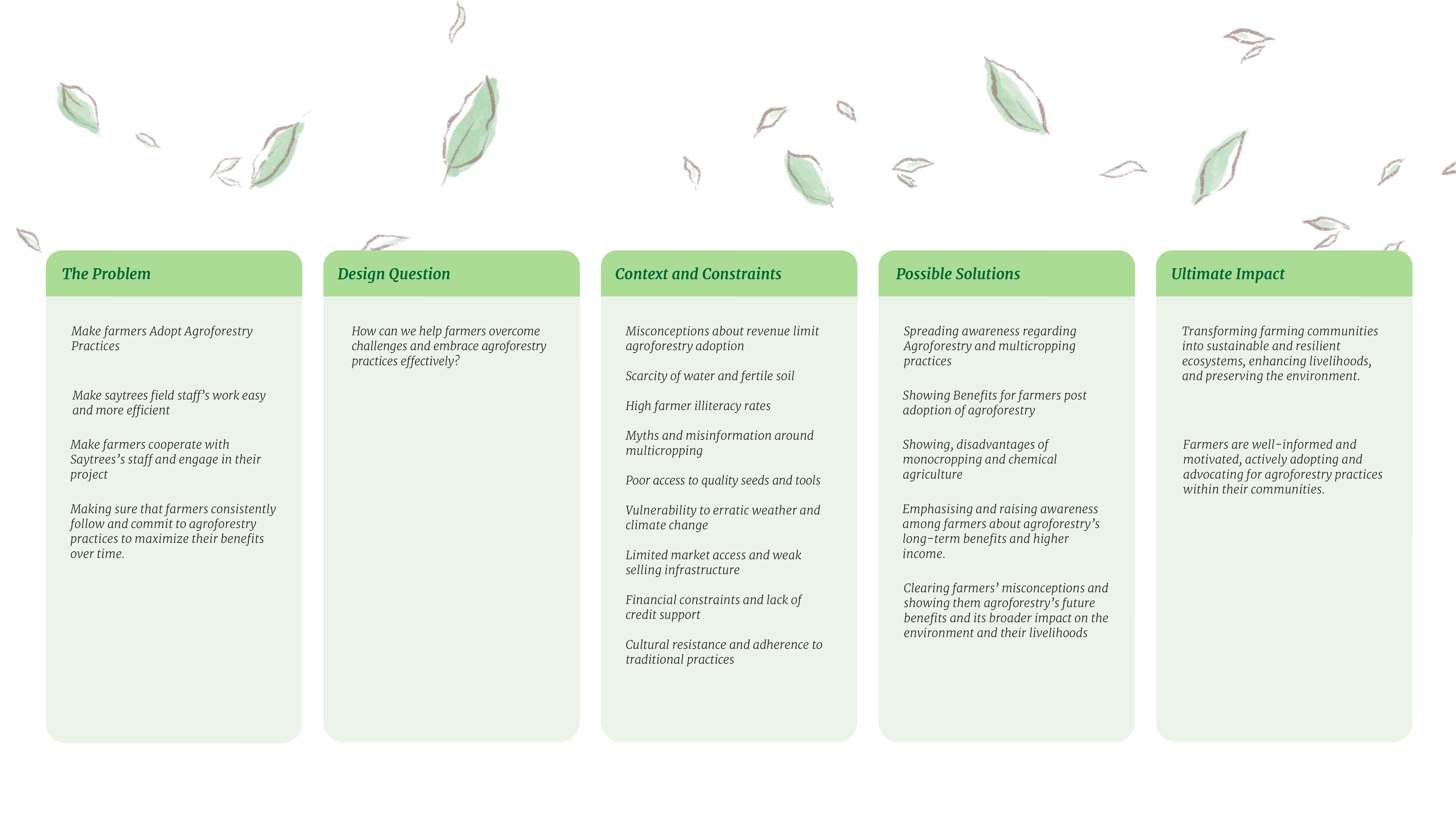
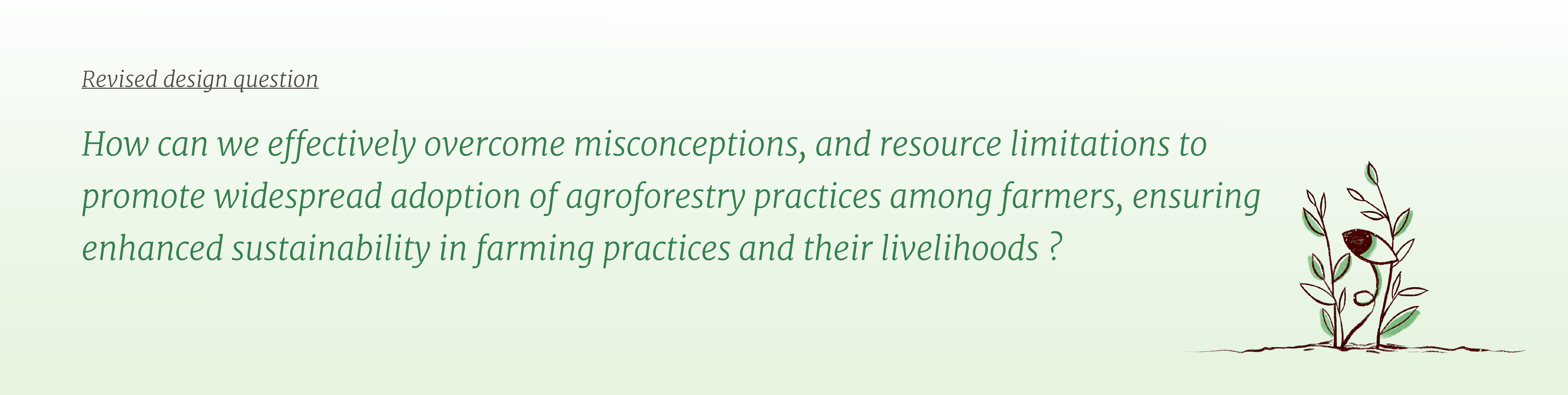
After understanding the challenge and the stakeholder ecosystem, including both the farmer and field team journeys we had a clear view of the gaps, the field situation, and the impact we wanted to achieve. This allowed us to outline possible solutions, contextual constraints, and key considerations and to define a revised design challenge to guide our next steps .
Framing the Design Challenge
After understanding the challenge and the stakeholder ecosystem, including both the farmer and field team journeys we had a clear view of the gaps, the field situation, and the impact we wanted to achieve. This allowed us to outline possible solutions, contextual constraints, and key considerations and to define a revised design challenge to guide our next steps .
Framing the Design Challenge
After understanding the challenge and the stakeholder ecosystem, including both the farmer and field team journeys we had a clear view of the gaps, the field situation, and the impact we wanted to achieve. This allowed us to outline possible solutions, contextual constraints, and key considerations and to define a revised design challenge to guide our next steps .
Co-creation Session
With the design question in place, we revisited the stakeholder journeys to validate our insights and gather additional perspectives. This led to the idea of a co-creation session where stakeholders could actively share their views.
We facilitated the session involving diverse stakeholders—farmers, field team members, implementation team, and partner NGO representatives. Participants were divided into mixed groups to ensure cross-perspectives and richer discussions.
We conducted three structured activities alongside open discussions:
Co-creation Session
With the design question in place, we revisited the stakeholder journeys to validate our insights and gather additional perspectives. This led to the idea of a co-creation session where stakeholders could actively share their views.
We facilitated the session involving diverse stakeholders—farmers, field team members, implementation team, and partner NGO representatives. Participants were divided into mixed groups to ensure cross-perspectives and richer discussions.
We conducted three structured activities alongside open discussions:
Co-creation Session
With the design question in place, we revisited the stakeholder journeys to validate our insights and gather additional perspectives. This led to the idea of a co-creation session where stakeholders could actively share their views.
We facilitated the session involving diverse stakeholders—farmers, field team members, implementation team, and partner NGO representatives. Participants were divided into mixed groups to ensure cross-perspectives and richer discussions.
We conducted three structured activities alongside open discussions:

Collective Brainstorming and Knowledge Sharing
Each group was assigned a topic and asked to brainstorm and record everything they knew pertaining to the assigned topic
They then presented their inputs to the larger group
This activity served as an information bank, helping us gauge their level of understanding, how they conveyed knowledge, and the ways they absorbed information
Collective Brainstorming and Knowledge Sharing
Each group was assigned a topic and asked to brainstorm and record everything they knew pertaining to the assigned topic
They then presented their inputs to the larger group
This activity served as an information bank, helping us gauge their level of understanding, how they conveyed knowledge, and the ways they absorbed information
Collective Brainstorming and Knowledge Sharing
Each group was assigned a topic and asked to brainstorm and record everything they knew pertaining to the assigned topic
They then presented their inputs to the larger group
This activity served as an information bank, helping us gauge their level of understanding, how they conveyed knowledge, and the ways they absorbed information

2. Field Team Journey Mapping
Field team members engaged in a card-sorting activity focused on communication touchpoints.
They mapped:
The purpose of each touchpoint in the journey
The communication mediums used in each of those touchpoints (e.g., in-person, WhatsApp, group meetings)
The topics they believed should be addressed at each stage
Three teams created separate versions of the implementation journey. By comparing these, we identified commonalities, gaps, and points of conflict, leading to a consolidated understanding of their perspectives.
2. Field Team Journey Mapping
Field team members engaged in a card-sorting activity focused on communication touchpoints.
They mapped:
The purpose of each touchpoint in the journey
The communication mediums used in each of those touchpoints (e.g., in-person, WhatsApp, group meetings)
The topics they believed should be addressed at each stage
Three teams created separate versions of the implementation journey. By comparing these, we identified commonalities, gaps, and points of conflict, leading to a consolidated understanding of their perspectives.
2. Field Team Journey Mapping
Field team members engaged in a card-sorting activity focused on communication touchpoints.
They mapped:
The purpose of each touchpoint in the journey
The communication mediums used in each of those touchpoints (e.g., in-person, WhatsApp, group meetings)
The topics they believed should be addressed at each stage
Three teams created separate versions of the implementation journey. By comparing these, we identified commonalities, gaps, and points of conflict, leading to a consolidated understanding of their perspectives.

Farmer-Centric Insights
Farmers participated in a parallel exercise focusing on what information they valued most, how they preferred it to be delivered, and by whom
They then ranked the same in order of preference
An open discussion was held to understand what information would have made enrollment easier for them, and what they felt was missing during their own journey
Farmer-Centric Insights
Farmers participated in a parallel exercise focusing on what information they valued most, how they preferred it to be delivered, and by whom
They then ranked the same in order of preference
An open discussion was held to understand what information would have made enrollment easier for them, and what they felt was missing during their own journey
Farmer-Centric Insights
Farmers participated in a parallel exercise focusing on what information they valued most, how they preferred it to be delivered, and by whom
They then ranked the same in order of preference
An open discussion was held to understand what information would have made enrollment easier for them, and what they felt was missing during their own journey

The Outcome
These activities, combined with group discussions and one-on-one interactions, helped us:
Validate the journey maps from our earlier analysis
Capture farmer preferences on communication and information needs
Understand field team perspectives on effective communication across touchpoints
Identify shared challenges, gaps, and opportunities across stakeholders
This co-creation approach not only validated our assumptions but also surfaced new, practical insights to guide the design of targeted interventions
The Outcome
These activities, combined with group discussions and one-on-one interactions, helped us:
Validate the journey maps from our earlier analysis
Capture farmer preferences on communication and information needs
Understand field team perspectives on effective communication across touchpoints
Identify shared challenges, gaps, and opportunities across stakeholders
This co-creation approach not only validated our assumptions but also surfaced new, practical insights to guide the design of targeted interventions
The Outcome
These activities, combined with group discussions and one-on-one interactions, helped us:
Validate the journey maps from our earlier analysis
Capture farmer preferences on communication and information needs
Understand field team perspectives on effective communication across touchpoints
Identify shared challenges, gaps, and opportunities across stakeholders
This co-creation approach not only validated our assumptions but also surfaced new, practical insights to guide the design of targeted interventions
Consolidating the Implementation Journey/Strategy
Building on the insights from the co-creation session, our next step was to finalize the touchpoints of an improved implementation journey and identify opportunities for intervention
We mapped the outputs of the three stakeholder groups, then layered in our own insights to streamline and iterate the journey
Through successive iterations, we:
Defined the stages of the journey and the themes to be addressed at each stage
Mapped communication mediums, and responsible stakeholders
Identified opportunity areas where interventions and tools could be integrated
Points of Alignment and Conflict
Most stakeholders agreed on the broad stages of the journey and the themes of communication
Key conflicts arose around:
Who delivers the communication (which stakeholder should handle which topics)
What medium is most effective at each touchpoint
Logistics of exposure visits: whether they should occur before enrollment, after enrollment, or both
The exposure visit emerged as the most debated element. After brainstorming, alternatives, such as using videos during meetings or limiting visits to shortlisted farmers—a consensus was reached.
The solution: Two village meetings (pre- and post-enrollment) with families
An exposure visit placed between the two meetings, ensuring both direct experience for some and indirect influence through word of mouth for the others.
Consolidating the Implementation Journey/Strategy
Building on the insights from the co-creation session, our next step was to finalize the touchpoints of an improved implementation journey and identify opportunities for intervention
We mapped the outputs of the three stakeholder groups, then layered in our own insights to streamline and iterate the journey
Through successive iterations, we:
Defined the stages of the journey and the themes to be addressed at each stage
Mapped communication mediums, and responsible stakeholders
Identified opportunity areas where interventions and tools could be integrated
Points of Alignment and Conflict
Most stakeholders agreed on the broad stages of the journey and the themes of communication
Key conflicts arose around:
Who delivers the communication (which stakeholder should handle which topics)
What medium is most effective at each touchpoint
Logistics of exposure visits: whether they should occur before enrollment, after enrollment, or both
The exposure visit emerged as the most debated element. After brainstorming, alternatives, such as using videos during meetings or limiting visits to shortlisted farmers—a consensus was reached.
The solution: Two village meetings (pre- and post-enrollment) with families
An exposure visit placed between the two meetings, ensuring both direct experience for some and indirect influence through word of mouth for the others.
Consolidating the Implementation Journey/Strategy
Building on the insights from the co-creation session, our next step was to finalize the touchpoints of an improved implementation journey and identify opportunities for intervention
We mapped the outputs of the three stakeholder groups, then layered in our own insights to streamline and iterate the journey
Through successive iterations, we:
Defined the stages of the journey and the themes to be addressed at each stage
Mapped communication mediums, and responsible stakeholders
Identified opportunity areas where interventions and tools could be integrated
Points of Alignment and Conflict
Most stakeholders agreed on the broad stages of the journey and the themes of communication
Key conflicts arose around:
Who delivers the communication (which stakeholder/channel should handle which topics)
What medium is most effective at each touchpoint
Logistics of exposure visits: whether they should occur before enrollment, after enrollment, or both
The exposure visit emerged as the most debated element. After brainstorming, alternatives, such as using videos during meetings or limiting visits to shortlisted farmers—a consensus was reached.
The solution: Two village meetings (pre- and post-enrollment) with families
An exposure visit placed between the two meetings, ensuring both direct experience for some and indirect influence through word of mouth for the others.
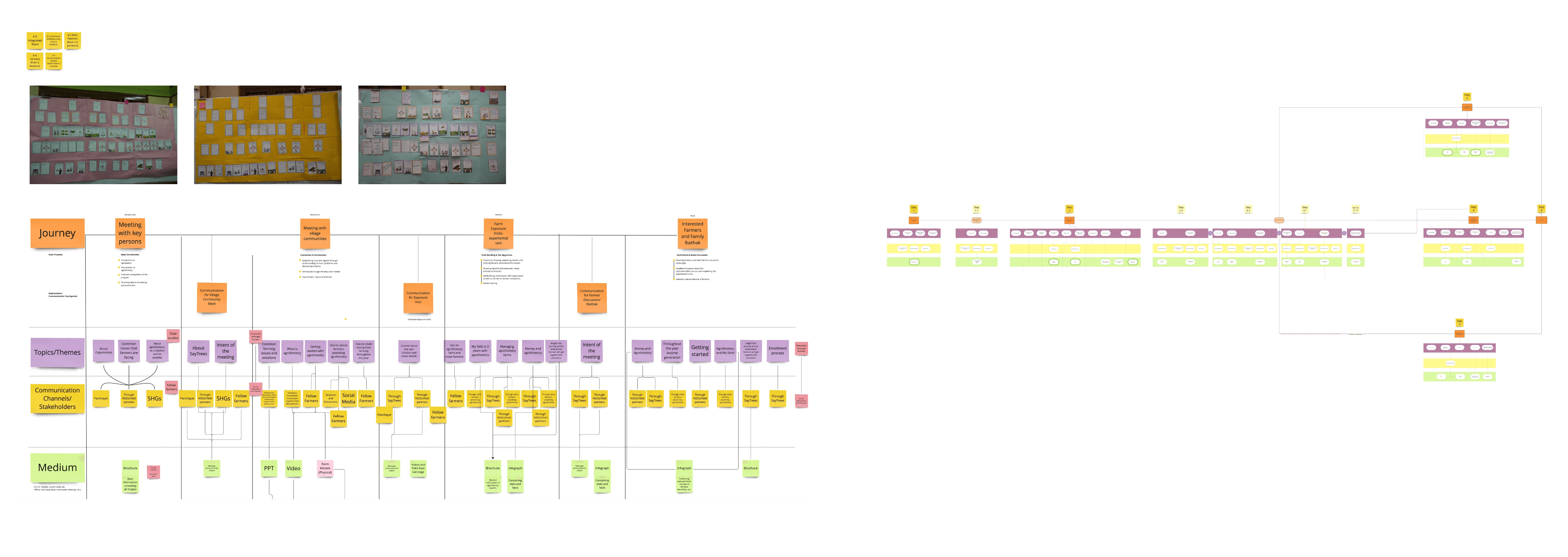
Evolving versions of the implementation journey from the one mapped by the stakeholder
Evolving versions of the implementation journey from the one mapped by the stakeholder
Evolving versions of the implementation journey from the one mapped by the stakeholder

Final Journey Strategy
The consolidated strategy mapped out:
Touchpoints across the farmer journey
Communication mediums tailored to each stage
Stakeholder channels clarifying responsibilities
Topics of discussion aligned with farmer needs and decision-making points
This strategy now serves as the final journey map, a structured pathway for testing the tools and interventions designed to improve farmer conversions and strengthen long-term adoption
Final Journey Strategy
The consolidated strategy mapped out:
Touchpoints across the farmer journey
Communication mediums tailored to each stage
Stakeholder channels clarifying responsibilities
Topics of discussion aligned with farmer needs and decision-making points
This strategy now serves as the final journey map, a structured pathway for testing the tools and interventions designed to improve farmer conversions and strengthen long-term adoption
Final Journey Strategy
The consolidated strategy mapped out:
Touchpoints across the farmer journey
Communication mediums tailored to each stage
Stakeholder channels clarifying responsibilities
Topics of discussion aligned with farmer needs and decision-making points
This strategy now serves as the final journey map, a structured pathway for testing the tools and interventions designed to improve farmer conversions and strengthen long-term adoption
Mapping the complete implementation journey — aligning touchpoints, communication mediums, stakeholders, and discussion topics.
Mapping the complete implementation journey — aligning touchpoints, communication mediums, stakeholders, and discussion topics.
Mapping the complete implementation journey — aligning touchpoints, communication mediums, stakeholders, and discussion topics.

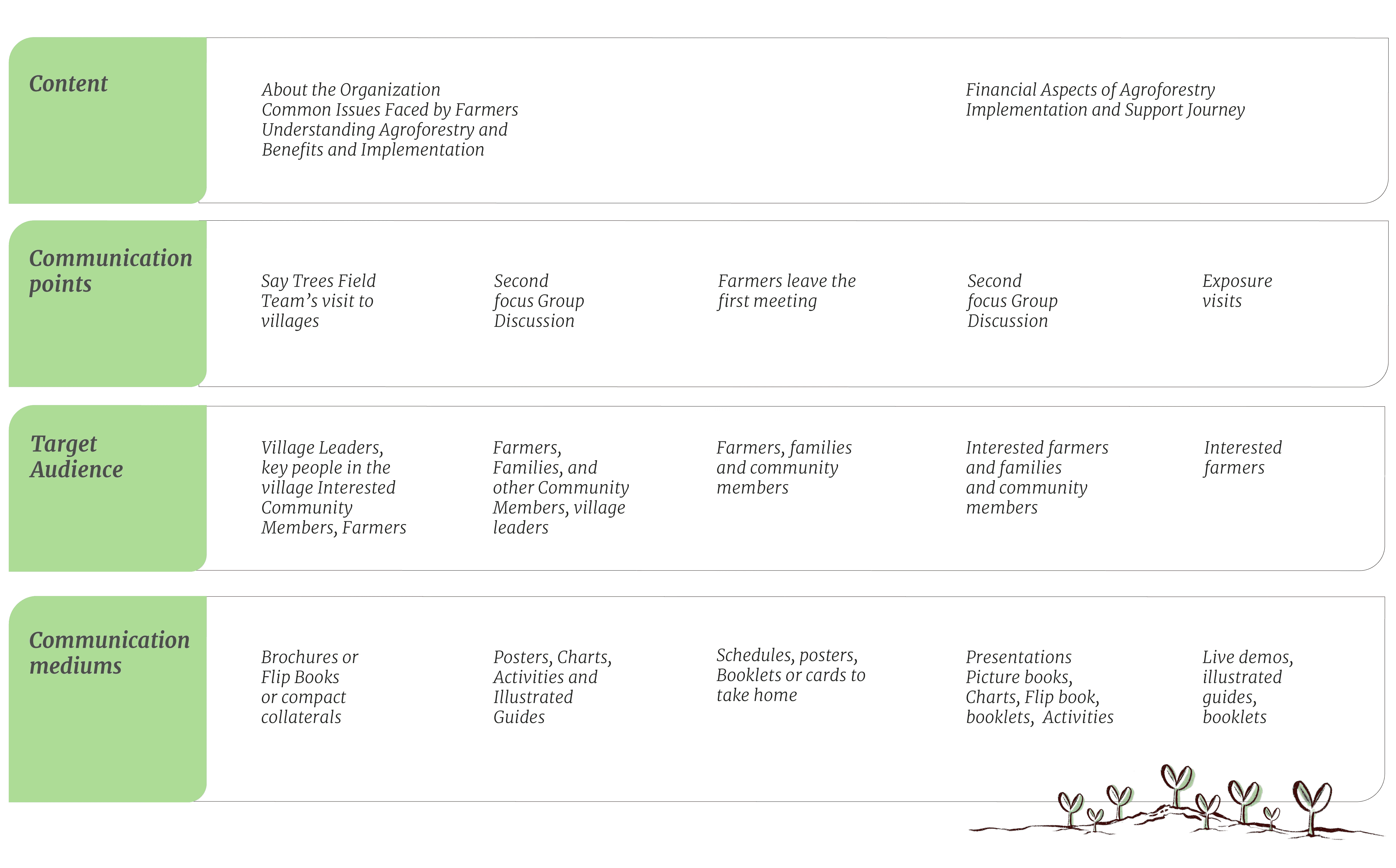
To sum up, we consolidated our possible interventions by mapping the core content to be communicated, the touchpoints where it should be delivered, the specific target audiences for each stage, and the mediums that were both preferred by farmers and feasible for the field team to use.
To sum up, we consolidated our possible interventions by mapping the core content to be communicated, the touchpoints where it should be delivered, the specific target audiences for each stage, and the mediums that were both preferred by farmers and feasible for the field team to use.
To sum up, we consolidated our possible interventions by mapping the core content to be communicated, the touchpoints where it should be delivered, the specific target audiences for each stage, and the mediums that were both preferred by farmers and feasible for the field team to use.
Finalised Tools
After consolidating all possible communication interventions, we narrowed down the final set of tools to design, guided by budget, logistics, and field feasibility
The selected tools included:
Introductory brochure: For initial engagement, illustrating the core idea of agroforestry, SayTrees’ role, and its tangible benefits
Farmer booklet: A detailed, easy-to-navigate reference given after the first meeting, covering the model, practices, and management insights
Presentation aid: A structured visual guide to support field team members during meetings and discussions with farmers
Success story videos: Real-life documentation of farmers’ journeys, used during sessions to build trust and offer relatable examples where exposure visits weren’t possible
Facilitation guide: Designed for field staff to navigate the new tools and the restructured implementation journey smoothly
Finalised Tools
After consolidating all possible communication interventions, we narrowed down the final set of tools to design, guided by budget, logistics, and field feasibility
The selected tools included:
Introductory brochure: For initial engagement, illustrating the core idea of agroforestry, SayTrees’ role, and its tangible benefits
Farmer booklet: A detailed, easy-to-navigate reference given after the first meeting, covering the model, practices, and management insights
Presentation aid: A structured visual guide to support field team members during meetings and discussions with farmers
Success story videos: Real-life documentation of farmers’ journeys, used during sessions to build trust and offer relatable examples where exposure visits weren’t possible
Facilitation guide: Designed for field staff to navigate the new tools and the restructured implementation journey smoothly
Finalised Tools
After consolidating all possible communication interventions, we narrowed down the final set of tools to design, guided by budget, logistics, and field feasibility
The selected tools included:
Introductory brochure: For initial engagement, illustrating the core idea of agroforestry, SayTrees’ role, and its tangible benefits
Farmer booklet: A detailed, easy-to-navigate reference given after the first meeting, covering the model, practices, and management insights
Presentation aid: A structured visual guide to support field team members during meetings and discussions with farmers
Success story videos: Real-life documentation of farmers’ journeys, used during sessions to build trust and offer relatable examples where exposure visits weren’t possible
Facilitation guide: Designed for field staff to navigate the new tools and the restructured implementation journey smoothly
Secondary study
Once the topics, mediums, and touchpoints of the final strategy were outlined, we conducted a secondary study to understand existing resources and approaches in communicating sustainable agricultural practices.
The study was carried out along two parallel tracks:
Agriculture-focused resources
Case studies, projects, and strategies from India and abroad
Manuals, publications, and tools addressing farmers’ culture, practices, and behaviors
Analysis of how agricultural content is structured, represented, and visualized in communication materials
Secondary study
Once the topics, mediums, and touchpoints of the final strategy were outlined, we conducted a secondary study to understand existing resources and approaches in communicating sustainable agricultural practices.
The study was carried out along two parallel tracks:
Agriculture-focused resources
Case studies, projects, and strategies from India and abroad
Manuals, publications, and tools addressing farmers’ culture, practices, and behaviors
Analysis of how agricultural content is structured, represented, and visualized in communication materials
Secondary study
Once the topics, mediums, and touchpoints of the final strategy were outlined, we conducted a secondary study to understand existing resources and approaches in communicating sustainable agricultural practices.
The study was carried out along two parallel tracks:
Agriculture-focused resources
Case studies, projects, and strategies from India and abroad
Manuals, publications, and tools addressing farmers’ culture, practices, and behaviors
Analysis of how agricultural content is structured, represented, and visualized in communication materials

Communication and design approaches
Examples of visual and communication strategies used in rural or niche contexts
Case studies of design for mindset change and impact-driven communication
Exploration of visual sensitivities and how design can adapt to specific audiences
Communication and design approaches
Examples of visual and communication strategies used in rural or niche contexts
Case studies of design for mindset change and impact-driven communication
Exploration of visual sensitivities and how design can adapt to specific audiences
Communication and design approaches
Examples of visual and communication strategies used in rural or niche contexts
Case studies of design for mindset change and impact-driven communication
Exploration of visual sensitivities and how design can adapt to specific audiences

This study helped identify effective methods of content structuring, representation, and language, while also highlighting visual strategies relevant to rural contexts. These learnings informed the design direction for the tools and interventions we would create.
This study helped identify effective methods of content structuring, representation, and language, while also highlighting visual strategies relevant to rural contexts. These learnings informed the design direction for the tools and interventions we would create.
This study helped identify effective methods of content structuring, representation, and language, while also highlighting visual strategies relevant to rural contexts. These learnings informed the design direction for the tools and interventions we would create.
Ideation and Process
After completing the secondary case study, we had a clearer sense of the form, the mediums should take and references for structuring both content and visuals. The next step was gathering the right content.
We organized a sit-down session with the agricultural experts and field team, mapping topics from the earlier co-creation session.The session combined open discussions with written inputs, shared insights and in group conversations.
This process resulted in a large pool of raw, technical knowledge, our primary resource to be later restructured into farmer-friendly narratives and formats. We also began iterations for the content structure as well as the visual aspects parallelly.
Ideation and Process
After completing the secondary case study, we had a clearer sense of the form, the mediums should take and references for structuring both content and visuals. The next step was gathering the right content.
We organized a sit-down session with the agricultural experts and field team, mapping topics from the earlier co-creation session.The session combined open discussions with written inputs, shared insights and in group conversations.
This process resulted in a large pool of raw, technical knowledge, our primary resource to be later restructured into farmer-friendly narratives and formats. We also began iterations for the content structure as well as the visual aspects parallelly.
Ideation and Process
After completing the secondary case study, we had a clearer sense of the form, the mediums should take and references for structuring both content and visuals. The next step was gathering the right content.
We organized a sit-down session with the agricultural experts and field team, mapping topics from the earlier co-creation session.The session combined open discussions with written inputs, shared insights and in group conversations.
This process resulted in a large pool of raw, technical knowledge, our primary resource to be later restructured into farmer-friendly narratives and formats. We also began iterations for the content structure as well as the visual aspects parallelly.
Content mapping session with agricultural experts — gathering insights and responses to key topic prompts.
Content mapping session with agricultural experts — gathering insights and responses to key topic prompts.

Structuring the Content
We explored multiple narrative formats—problem-solution, Q&A type structure, and story-led approaches among many others —before arriving at a simple flow for the first offical draft : Introduce a relatable farmer, set the scene with struggles, present agroforestry as a solution, highlight benefits and success stories, introduce SayTrees as a partner, and end with a call-to-action.
The same structure shaped two formats:
Brochure: Concise storytelling around farmer challenges, agroforestry, and its benefits for farmers, environment, and community, leading to a call to action
Booklet: A deeper dive handed out after second in-person discussions, with detailed benefits, success stories, farm management insights, and a comparative study of monocropping and multicropping
Structuring the Content
We explored multiple narrative formats—problem-solution, Q&A type structure, and story-led approaches among many others —before arriving at a simple flow for the first offical draft : Introduce a relatable farmer, set the scene with struggles, present agroforestry as a solution, highlight benefits and success stories, introduce SayTrees as a partner, and end with a call-to-action.
The same structure shaped two formats:
Brochure: Concise storytelling around farmer challenges, agroforestry, and its benefits for farmers, environment, and community, leading to a call to action
Booklet: A deeper dive handed out after second in-person discussions, with detailed benefits, success stories, farm management insights, and a comparative study of monocropping and multicropping
Structuring the Content
We explored multiple narrative formats—problem-solution, Q&A type structure, and story-led approaches among many others —before arriving at a simple flow for the first offical draft : Introduce a relatable farmer, set the scene with struggles, present agroforestry as a solution, highlight benefits and success stories, introduce SayTrees as a partner, and end with a call-to-action.
The same structure shaped two formats:
Brochure: Concise storytelling around farmer challenges, agroforestry, and its benefits for farmers, environment, and community, leading to a call to action
Booklet: A deeper dive handed out after second in-person discussions, with detailed benefits, success stories, farm management insights, and a comparative study of monocropping and multicropping
Ideating Visual Language
Based on secondary study references and on-field references and farmer tastes, we developed and tested styles with farmers via a WhatsApp poll. They preferred a detailed but simple look with highlights and shadows over flat or minimal graphics. Icons also worked better when illustrative rather than abstract. Colors and forms were drawn from their environment to keep the style grounded and relatable.
Ideating Visual Language
Based on secondary study references and on-field references and farmer tastes, we developed and tested styles with farmers via a WhatsApp poll. They preferred a detailed but simple look with highlights and shadows over flat or minimal graphics. Icons also worked better when illustrative rather than abstract. Colors and forms were drawn from their environment to keep the style grounded and relatable.
Ideating Visual Language
Based on secondary study references and on-field references and farmer tastes, we developed and tested styles with farmers via a WhatsApp poll. They preferred a detailed but simple look with highlights and shadows over flat or minimal graphics. Icons also worked better when illustrative rather than abstract. Colors and forms were drawn from their environment to keep the style grounded and relatable.
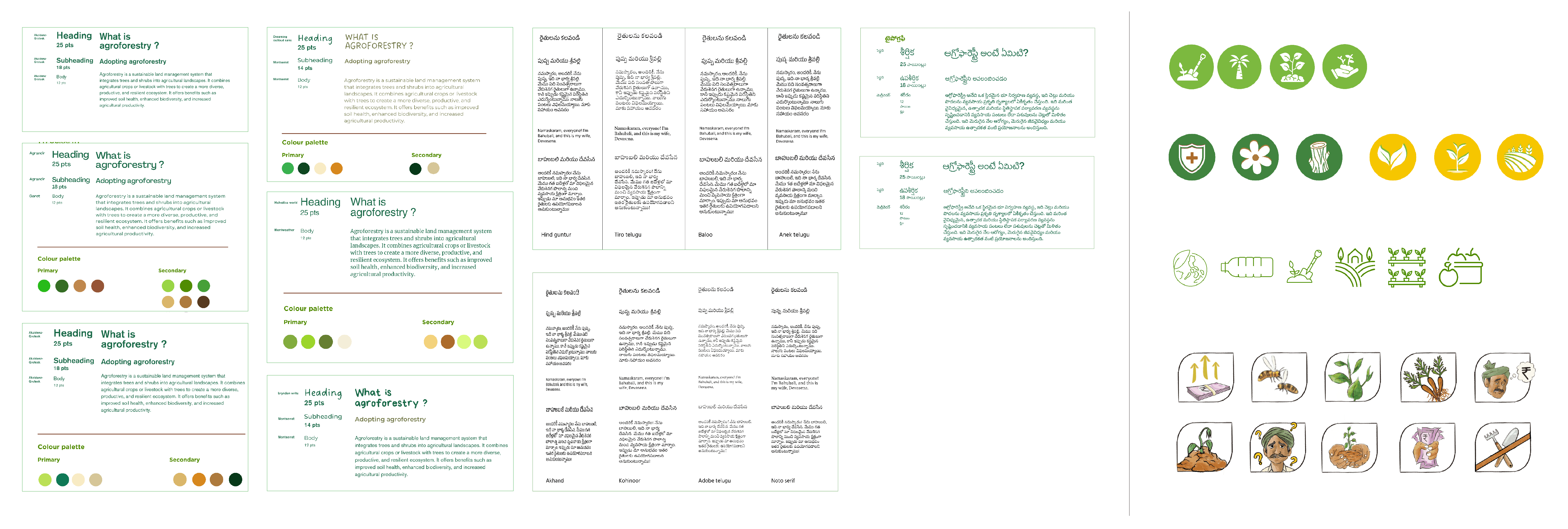
Illustration style and visual components - Initial explorations and iterations
Illustration style and visual components - Initial explorations and iterations
Illustration style and visual components - Initial explorations and iterations

Type combination (english and Telugu) explorations and icon explorations
Type combination (english and Telugu) explorations and icon explorations
Type combination (english and Telugu) explorations and icon explorations
Once we had a base visual style that aligned with the majority preference, and simplified content in place, we began iterating on the first collateral: the brochure.
Initially planned as a trifold, we quickly realized this format couldn’t accommodate the visualizations, so we shifted to a fourfold design. After five to six iterations, it became clear that a change in narrative was also needed.
I’ve documented this journey, showing how the early versions evolved and eventually led us to reframe both the structure and storytelling approach.
Once we had a base visual style that aligned with the majority preference, and simplified content in place, we began iterating on the first collateral: the brochure.
Initially planned as a trifold, we quickly realized this format couldn’t accommodate the visualizations, so we shifted to a fourfold design. After five to six iterations, it became clear that a change in narrative was also needed.
I’ve documented this journey, showing how the early versions evolved and eventually led us to reframe both the structure and storytelling approach.
Once we had a base visual style that aligned with the majority preference, and simplified content in place, we began iterating on the first collateral: the brochure.
Initially planned as a trifold, we quickly realized this format couldn’t accommodate the visualizations, so we shifted to a fourfold design. After five to six iterations, it became clear that a change in narrative was also needed.
I’ve documented this journey, showing how the early versions evolved and eventually led us to reframe both the structure and storytelling approach.
All brochure iterations mapped; The process of refinement and evolution.
All brochure iterations mapped; The process of refinement and evolution.
All brochure iterations mapped; The process of refinement and evolution.

Strategic Narrative Shift
After multiple brochure iterations, one insight stood out: the content felt too academic and struggled to hold attention. Farmers engaged better with familiar cultural references, especially storylines and characters from popular regional films
This finding led to a strategic shift:
Replace purely informational storytelling with a character-driven narrative
Introduce relatable figures inspired by films (Pushpa and Bahubali were farmer favourites), along with their families, to make the story grounded and culturally resonant
Use a before–after farm transformation as a continuous visual thread across the brochure
This shift laid the foundation for the next set of iterations, where characters, families, and stories became the central medium for communicating agroforestry
Strategic Narrative Shift
After multiple brochure iterations, one insight stood out: the content felt too academic and struggled to hold attention. Farmers engaged better with familiar cultural references, especially storylines and characters from popular regional films
This finding led to a strategic shift:
Replace purely informational storytelling with a character-driven narrative
Introduce relatable figures inspired by films (Pushpa and Bahubali were farmer favourites), along with their families, to make the story grounded and culturally resonant
Use a before–after farm transformation as a continuous visual thread across the brochure
This shift laid the foundation for the next set of iterations, where characters, families, and stories became the central medium for communicating agroforestry
Strategic Narrative Shift
After multiple brochure iterations, one insight stood out: the content felt too academic and struggled to hold attention. Farmers engaged better with familiar cultural references, especially storylines and characters from popular regional films
This finding led to a strategic shift:
Replace purely informational storytelling with a character-driven narrative
Introduce relatable figures inspired by films (Pushpa and Bahubali were farmer favourites), along with their families, to make the story grounded and culturally resonant
Use a before–after farm transformation as a continuous visual thread across the brochure
This shift laid the foundation for the next set of iterations, where characters, families, and stories became the central medium for communicating agroforestry
Early silhouette explorations to capture farmer profiles
Early silhouette explorations to capture farmer profiles
Early silhouette explorations to capture farmer profiles

The next step was developing a continuous background that could run across the folds of the fourfold, allowing smooth transitions to be shown. This stark contrast supported the narrative flow and also made the “before and after” shift visually clear for farmers. Even if the content wasn’t fully absorbed, the visuals alone could communicate the scale of transformation.
The next step was developing a continuous background that could run across the folds of the fourfold, allowing smooth transitions to be shown. This stark contrast supported the narrative flow and also made the “before and after” shift visually clear for farmers. Even if the content wasn’t fully absorbed, the visuals alone could communicate the scale of transformation.
The next step was developing a continuous background that could run across the folds of the fourfold, allowing smooth transitions to be shown. This stark contrast supported the narrative flow and also made the “before and after” shift visually clear for farmers. Even if the content wasn’t fully absorbed, the visuals alone could communicate the scale of transformation.
Exploring a continuous background illustrating the shift from drought to thriving farmland
Exploring a continuous background illustrating the shift from drought to thriving farmland
Exploring a continuous background illustrating the shift from drought to thriving farmland


With the shift toward a family-centered narrative, the next step was to develop characters based on the likeness of their counterparts. Once the basic designs were established, these were incorporated into the storyline, leading to multiple iterations. At one point, we experimented with adding a narrator voice but realized it felt excessive, and instead made Bahubali the direct representative of agroforestry for the farmers.
With the shift toward a family-centered narrative, the next step was to develop characters based on the likeness of their counterparts. Once the basic designs were established, these were incorporated into the storyline, leading to multiple iterations. At one point, we experimented with adding a narrator voice but realized it felt excessive, and instead made Bahubali the direct representative of agroforestry for the farmers.
With the shift toward a family-centered narrative, the next step was to develop characters based on the likeness of their counterparts. Once the basic designs were established, these were incorporated into the storyline, leading to multiple iterations. At one point, we experimented with adding a narrator voice but realized it felt excessive, and instead made Bahubali the direct representative of agroforestry for the farmers.


Prototype of the latest brochure draft to be taken forward for farmer testing
Prototype of the latest brochure draft to be taken forward for farmer testing
Prototype of the latest brochure draft to be taken forward for farmer testing


The layouts were refined accordingly, resulting in an iteration that balanced field data visualization with the family and character-driven narrative. This version was well received by the client and selected for on-field testing, with scope for further refinement based on farmer feedback.
The layouts were refined accordingly, resulting in an iteration that balanced field data visualization with the family and character-driven narrative. This version was well received by the client and selected for on-field testing, with scope for further refinement based on farmer feedback.
The layouts were refined accordingly, resulting in an iteration that balanced field data visualization with the family and character-driven narrative. This version was well received by the client and selected for on-field testing, with scope for further refinement based on farmer feedback.
Developing the second communication tool
The next step was to create the more extensive booklet. Unlike the brochure, this format allowed us to present the same content and much more in greater depth, making it suitable for the second meeting with farmers- when they already had some context and were more inclined to engage. The booklet was also intended to reach families, giving them a clearer understanding of agroforestry, not just its benefits but also the responsibilities that come with it.
In essence, it offered a more realistic picture of what life could look like once adoption began.
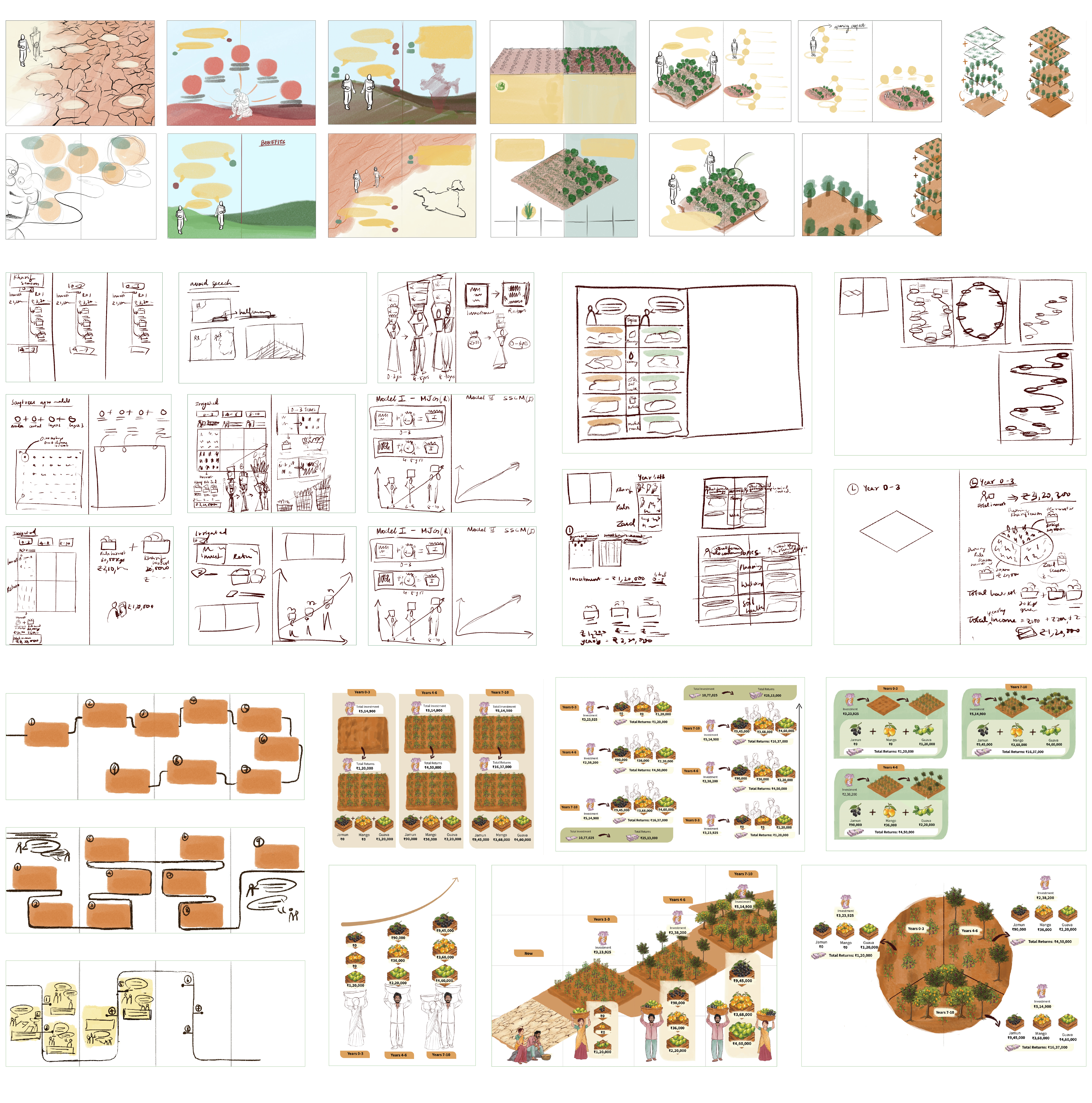
To achieve this, we explored basic layouts, storyboarded possible flows, and experimented with different ways of visualizing data points—such as agro models, revenue projections, and expected growth.
Various approaches were explored to ensure both clarity and relatability. Once the storyboards and visualization styles were finalized, we proceeded to develop the final drafts of the booklet spreads.
Developing the second communication tool
The next step was to create the more extensive booklet. Unlike the brochure, this format allowed us to present the same content and much more in greater depth, making it suitable for the second meeting with farmers- when they already had some context and were more inclined to engage. The booklet was also intended to reach families, giving them a clearer understanding of agroforestry, not just its benefits but also the responsibilities that come with it.
In essence, it offered a more realistic picture of what life could look like once adoption began.
To achieve this, we explored basic layouts, storyboarded possible flows, and experimented with different ways of visualizing data points—such as agro models, revenue projections, and expected growth.
Various approaches were explored to ensure both clarity and relatability. Once the storyboards and visualization styles were finalized, we proceeded to develop the final drafts of the booklet spreads.
Developing the second communication tool
The next step was to create the more extensive booklet. Unlike the brochure, this format allowed us to present the same content and much more in greater depth, making it suitable for the second meeting with farmers- when they already had some context and were more inclined to engage. The booklet was also intended to reach families, giving them a clearer understanding of agroforestry, not just its benefits but also the responsibilities that come with it.
In essence, it offered a more realistic picture of what life could look like once adoption began.
To achieve this, we explored basic layouts, storyboarded possible flows, and experimented with different ways of visualizing data points—such as agro models, revenue projections, and expected growth.
Various approaches were explored to ensure both clarity and relatability. Once the storyboards and visualization styles were finalized, we proceeded to develop the final drafts of the booklet spreads.
Layout and visual explorations for the booklet spreads
Layout and visual explorations for the booklet spreads
Refined spreads from the final booklet design, consolidating content and visual direction
Refined spreads from the final booklet design, consolidating content and visual direction
Refined spreads from the final booklet design, consolidating content and visual direction


Prototype of the final booklet draft prepared for on-ground testing with farmers
Prototype of the final booklet draft prepared for on-ground testing with farmers
Prototype of the final booklet draft prepared for on-ground testing with farmers


Finalization of Collaterals
After completing the booklet spreads, the final drafts were prepared for field testing. These would later inform further improvements and iterations based on real-world feedback.
Alongside the brochure and booklet, an interactive presentation was developed to facilitate engagement sessions with farmers. This presentation allowed facilitators to pause, ask questions, and introduce the characters dynamically. The aim was to maintain continuity of the narrative across all touchpoints, ensuring that the characters remained a central part of the learning experience throughout initial meetings and subsequent engagements.
A facilitation guide was also planned to support field team members in using these tools effectively. Additionally, real-life farmer success stories were intended to be documented as videos, providing exposure to those unable to attend farm visits.
These initiatives are slated for development after field testing, as the project is still in a developmental stage.
Finalization of Collaterals
After completing the booklet spreads, the final drafts were prepared for field testing. These would later inform further improvements and iterations based on real-world feedback.
Alongside the brochure and booklet, an interactive presentation was developed to facilitate engagement sessions with farmers. This presentation allowed facilitators to pause, ask questions, and introduce the characters dynamically. The aim was to maintain continuity of the narrative across all touchpoints, ensuring that the characters remained a central part of the learning experience throughout initial meetings and subsequent engagements.
A facilitation guide was also planned to support field team members in using these tools effectively. Additionally, real-life farmer success stories were intended to be documented as videos, providing exposure to those unable to attend farm visits.
These initiatives are slated for development after field testing, as the project is still in a developmental stage.
Finalization of Collaterals
After completing the booklet spreads, the final drafts were prepared for field testing. These would later inform further improvements and iterations based on real-world feedback.
Alongside the brochure and booklet, an interactive presentation was developed to facilitate engagement sessions with farmers. This presentation allowed facilitators to pause, ask questions, and introduce the characters dynamically. The aim was to maintain continuity of the narrative across all touchpoints, ensuring that the characters remained a central part of the learning experience throughout initial meetings and subsequent engagements.
A facilitation guide was also planned to support field team members in using these tools effectively. Additionally, real-life farmer success stories were intended to be documented as videos, providing exposure to those unable to attend farm visits.
These initiatives are slated for development after field testing, as the project is still in a developmental stage.
Presentation designed to support farmer sessions, featuring recurring characters and visual cues to help field teams facilitate discussions
Presentation designed to support farmer sessions, featuring recurring characters and visual cues to help field teams facilitate discussions
Presentation designed to support farmer sessions, featuring recurring characters and visual cues to help field teams facilitate discussions

Independent Exploration: App Interface
During periods when the client was briefly unavailable, I independently explored improvements to the organization’s farmer data collection app. This app is used to register and track interested farmers data and records.
While the project was paused, I reviewed the app’s UI, identified inconsistencies, and proposed refinements to improve usability and align it with the organization’s existing brand language.
This exercise served as a parallel exploration within my graduation project and provided an opportunity to address a different facet of the overall system.
Independent Exploration: App Interface
During periods when the client was briefly unavailable, I independently explored improvements to the organization’s farmer data collection app. This app is used to register and track interested farmers data and records.
While the project was paused, I reviewed the app’s UI, identified inconsistencies, and proposed refinements to improve usability and align it with the organization’s existing brand language.
This exercise served as a parallel exploration within my graduation project and provided an opportunity to address a different facet of the overall system.
Independent Exploration: App Interface
During periods when the client was briefly unavailable, I independently explored improvements to the organization’s farmer data collection app. This app is used to register and track interested farmers data and records.
While the project was paused, I reviewed the app’s UI, identified inconsistencies, and proposed refinements to improve usability and align it with the organization’s existing brand language.
This exercise served as a parallel exploration within my graduation project and provided an opportunity to address a different facet of the overall system.
Information architecture mapping of the existing app, outlining the flow across key screens and functions
Information architecture mapping of the existing app, outlining the flow across key screens and functions
Information architecture mapping of the existing app, outlining the flow across key screens and functions
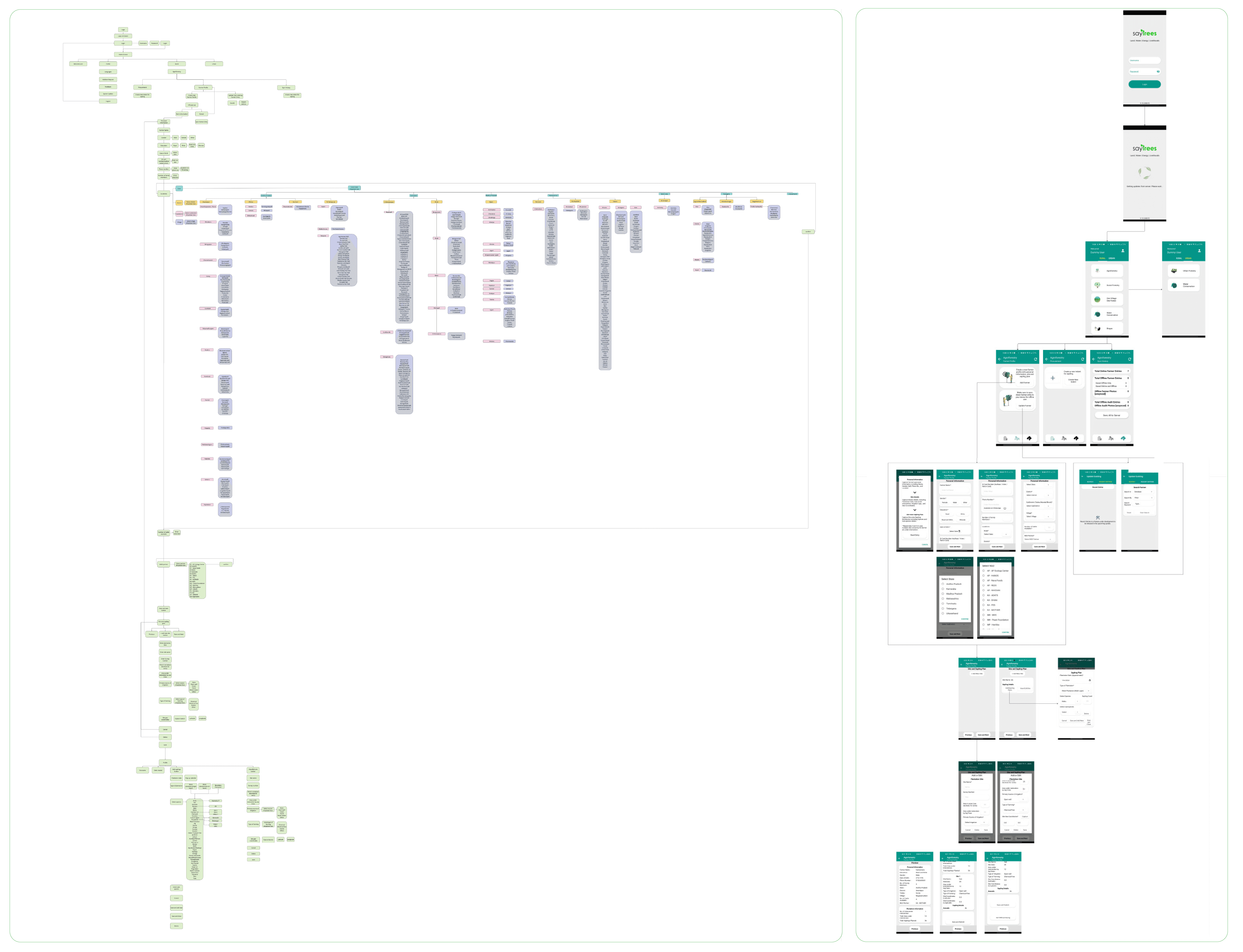
Snapshots from the existing app alongside a rough redesign exercise to explore improved visual consistency and navigation
Snapshots from the existing app alongside a rough redesign exercise to explore improved visual consistency and navigation
Snapshots from the existing app alongside a rough redesign exercise to explore improved visual consistency and navigation

A rough prototype of the redesigned screens developed as an exploratory exercise.
A rough prototype of the redesigned screens developed as an exploratory exercise.
A rough prototype of the redesigned screens developed as an exploratory exercise.

Solution and Outcomes
Shifted the narrative from purely informational to story-driven, increasing relatability and engagement
Enabled clearer communication of agroforestry’s long-term benefits to both farmers and their families
Established a suite of tools for farmer engagement, combining visual storytelling (brochure, booklet, character-based narratives), interactive formats (presentation), for the farmers and to aid the field teams, that can be tested, refined, and scaled across field contexts
Strengthened organizational capacity with a more streamlined journey strategy and collaterals that balance depth of information with accessibility
Together, these ensured consistency, relatability, and adaptability across multiple touchpoints.
Solution and Outcomes
Shifted the narrative from purely informational to story-driven, increasing relatability and engagement
Enabled clearer communication of agroforestry’s long-term benefits to both farmers and their families
Established a suite of tools for farmer engagement, combining visual storytelling (brochure, booklet, character-based narratives), interactive formats (presentation), for the farmers and to aid the field teams, that can be tested, refined, and scaled across field contexts
Strengthened organizational capacity with a more streamlined journey strategy and collaterals that balance depth of information with accessibility
Together, these ensured consistency, relatability, and adaptability across multiple touchpoints.
Solution and Outcomes
Shifted the narrative from purely informational to story-driven, increasing relatability and engagement
Enabled clearer communication of agroforestry’s long-term benefits to both farmers and their families
Established a suite of tools for farmer engagement, combining visual storytelling (brochure, booklet, character-based narratives), interactive formats (presentation), for the farmers and to aid the field teams, that can be tested, refined, and scaled across field contexts
Strengthened organizational capacity with a more streamlined journey strategy and collaterals that balance depth of information with accessibility
Together, these ensured consistency, relatability, and adaptability across multiple touchpoints.
Key Learnings and Future Improvements
Narrative framing is crucial: positioning agroforestry within a family context significantly improved resonance
Visual transitions (before/after land use, layered storytelling) helped overcome barriers and improve comprehension
Prototyping and testing at each stage ensured design choices were grounded in both client input and on-ground realities
Tools need to engage not just farmers but their families, whose support influences decisions
Field-test the brochure, presentation, and booklet to derive deeper insights and improve content, structure, and visuals
Evaluate how smoothly the implementation journey works and curate the facilitation guide for field team support
Establish a more reliable communication channel with farmers, enabling testing of existing content and gauging preferences to save time and enhance relevance
Complete or reach a stable stage with content before iterating on visuals to minimize layout disruptions
Explore additional interventions, such as spatial setups or tangible demonstrative aids, to simplify concepts and make the experience more engaging for farmers and facilitators
Key Learnings and Future Improvements
Narrative framing is crucial: positioning agroforestry within a family context significantly improved resonance
Visual transitions (before/after land use, layered storytelling) helped overcome barriers and improve comprehension
Prototyping and testing at each stage ensured design choices were grounded in both client input and on-ground realities
Tools need to engage not just farmers but their families, whose support influences decisions
Field-test the brochure, presentation, and booklet to derive deeper insights and improve content, structure, and visuals
Evaluate how smoothly the implementation journey works and curate the facilitation guide for field team support
Establish a more reliable communication channel with farmers, enabling testing of existing content and gauging preferences to save time and enhance relevance
Complete or reach a stable stage with content before iterating on visuals to minimize layout disruptions
Explore additional interventions, such as spatial setups or tangible demonstrative aids, to simplify concepts and make the experience more engaging for farmers and facilitators
Key Learnings and Future Improvements
Narrative framing is crucial: positioning agroforestry within a family context significantly improved resonance
Visual transitions (before/after land use, layered storytelling) helped overcome barriers and improve comprehension
Prototyping and testing at each stage ensured design choices were grounded in both client input and on-ground realities
Tools need to engage not just farmers but their families, whose support influences decisions
Field-test the brochure, presentation, and booklet to derive deeper insights and improve content, structure, and visuals
Evaluate how smoothly the implementation journey works and curate the facilitation guide for field team support
Establish a more reliable communication channel with farmers, enabling testing of existing content and gauging preferences to save time and enhance relevance
Complete or reach a stable stage with content before iterating on visuals to minimize layout disruptions
Explore additional interventions, such as spatial setups or tangible demonstrative aids, to simplify concepts and make the experience more engaging for farmers and facilitators
Not everything here's polished yet, but the heart of it is here :)
Thanks for visiting!
Not everything here's polished yet, but the heart of it is here :)
Thanks for visiting!
Not everything here's polished yet, but the heart of it is here :)
Thanks for visiting!